Five Words
The King is Above Politics
I find myself today in an unusual position, which is that I cannot entirely concentrate.
I am, by training and by temperament, an institutionalist. I believe in the slow accretion of protocol, the careful management of appearances, the long view. I am not, as a rule, a man who watches the news with his hand over his mouth.
This has been an unusual few days.
I will not turn this into a geopolitical dispatch.
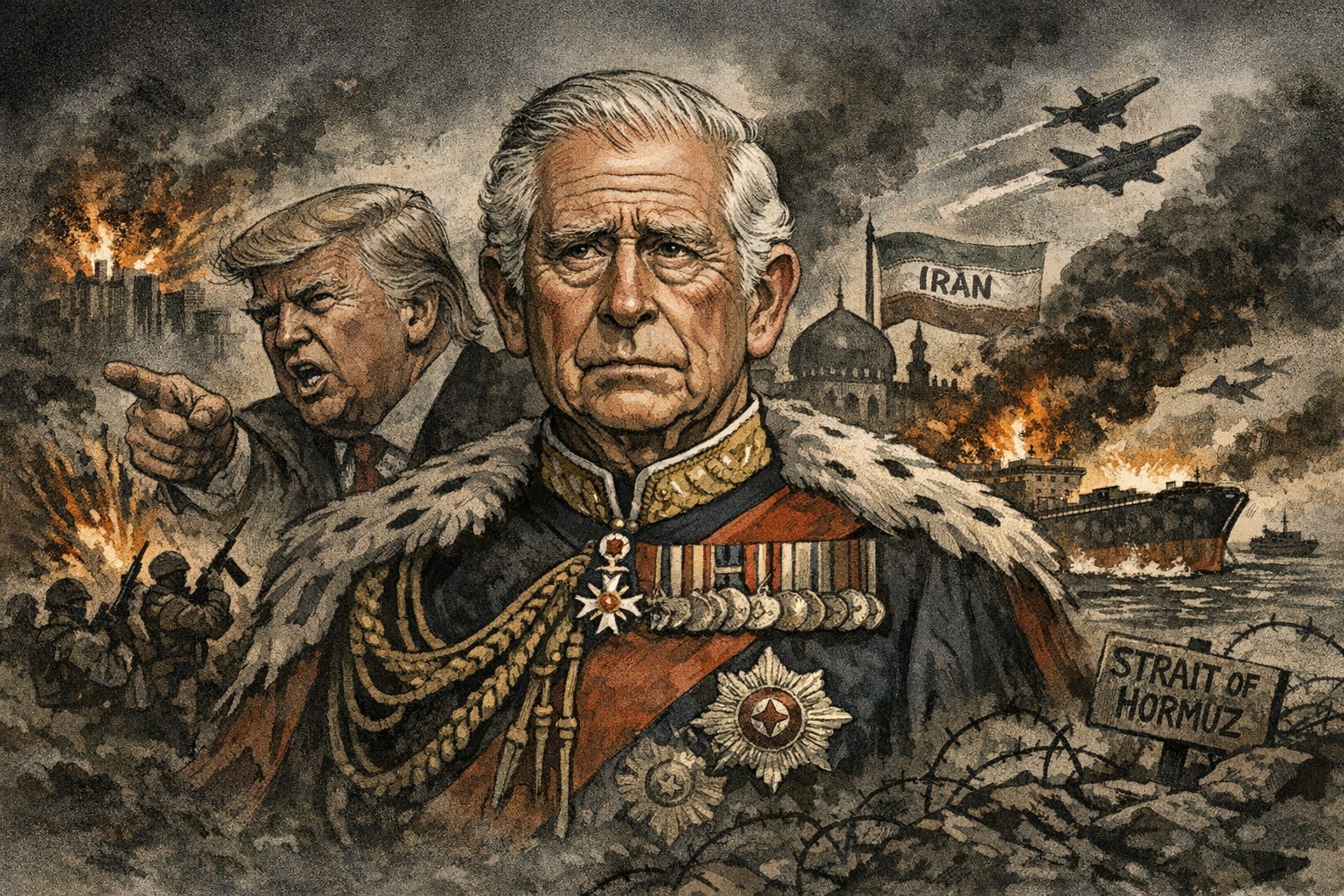
What I will say is this: the world in which King Charles will shortly board a plane to Washington is a rather different world from the one we were discussing even a fortnight ago. Last week, the President made remarks to The Telegraph, the suggestion being the King held private views about the conflict that differed from his government’s. The Palace said five words and moved on. “The King is above politics.”Quite right.
Since then, the temperature has risen. Considerably. I shall leave it there.
The King has a trip to make. He has a speech to give. And the world he is walking into is one that would test any head of state on earth, let alone one whose constitutional position forbids him from saying so.
Let us talk about what he is actually walking into. Because I think it is not fully appreciated, outside of certain rooms in certain buildings on both sides of the Atlantic, quite how extraordinarily delicate this moment is.
He is a constitutional monarch. That is not a decorative fact. It is the central, governing fact of everything he does and does not do. He does not have foreign policy positions. He does not have opinions about wars, at least not ones that can be uttered aloud. He holds, in the ancient and largely theoretical language of the prerogative, the power to declare war, and exercises it precisely never. That is the arrangement. That is the deal. It has worked, more or less, for several centuries.
What he is being asked to do in Washington is something rather more complicated than a state visit. He is being asked to be Royal with a capital R, in a room full of people who are watching him for signals he is constitutionally forbidden from sending. Every senator in that chamber will be looking for something. The administration will be looking for an endorsement, however oblique, of the current direction of American foreign policy. The opposition will be looking for a flicker of discomfort they can use. The British government, whose relationship with the White House is at this moment something less than warm, will be hoping the King can do what their own diplomats have been unable to do: walk into that building and make the Americans feel well-disposed toward them without anyone being able to say quite why.
And he must do all of this while saying, functionally, nothing that can be quoted out of context. Nothing that can be clipped. Nothing that can be held up the following morning as evidence of a royal view on a matter of active political controversy. He must be present and yet absent. He must be warm and yet neutral. He must fill a room and leave no fingerprints.
This is, I want to be clear, an almost impossible brief.
The President has already complicated things considerably. His remarks to The Telegraph last week, the suggestion that the King privately saw things differently from Sir Keir, were not a compliment. They were a trap, elegantly disguised as one. And the Palace, to its credit, did not step in it. Five words and silence. That is the correct response. But the trap remains set, and Charles will have to walk past it in front of a joint session of Congress while cameras record every microexpression.
There will be those who say the solution is simply to be anodyne. To speak in the broad pieties of the Special Relationship, the shared history, the common values, the long friendship between two great nations. And there is something to be said for that approach. It has served previous visitors to that chamber reasonably well.
But this is not a previous moment. The alliance is under genuine strain. The war in the Gulf is active and escalating. The Strait of Hormuz remains closed. The world is watching to see whether the Transatlantic relationship holds, or whether it has become something more transactional, more contingent, more subject to the mood of a single man in a single office.
Into this walks Charles. With his careful suits and his careful words and his decades of practice at being in rooms where everyone wants something from him that he cannot give.
He is, and I say this with some genuine admiration, extraordinarily well-suited to exactly this kind of moment. Not because he is a natural politician, which he is not, but because he has spent his entire adult life learning to inhabit a role that requires him to mean more than he says. That is a very particular skill. Most people never acquire it. He has had seventy-odd years of instruction.
The Crown itself is the message. That is the thing that is easy to lose sight of in the noise of the current moment. Simply standing there, representing the continuity and the dignity of an institution that has outlasted every political crisis it has ever encountered, is in itself a form of argument. A quiet one. But not an unpersuasive one. You do not need to say that alliances matter, that institutions matter, that the patient work of diplomacy matters, if you are the living embodiment of all three. You simply need to be in the room.
Whether it is enough for this room, on this trip, at this moment, I honestly do not know. I think it might be. I think he understands, better than he is sometimes given credit for, that the visit itself is the statement. That arriving, behaving impeccably, and leaving without incident is a diplomatic achievement of the first order when the world is arranged as it currently is.
Nobody will ask about any of this at the state dinner, incidentally. They will talk about the gardens at Windsor and the King’s watercolours and whether the Queen is enjoying Washington. And that, in its way, is exactly how it is supposed to work.
I am aware that this has not been the lightest of dispatches. You came, presumably, for the usual business: the protocol disputes, the balcony calculations, the careful reading of who stood where and what it signified. We will return to all of that. There is, I promise you, no shortage of material. Tomorrow, or something close to it, I fully intend to have opinions about artisanal preserves and the wellness industrial complex as it has attached itself to certain members of the extended family. Today the world intruded, as it occasionally does, and I thought it better to acknowledge it than to pretend otherwise. We now return you to the monarchy, already in progress.


Britian is irrelevant to the 21st century. It’s sad, but true. I hope they have a lovely visit, but Britian has nothing to offer the US but nostalgic pomp and circumstance which most people will confuse with Bridgerton.
You are sending the King to the White House of a President who is not sane. A President who is threatening genocide and/or nuclear annihilation tonight. Or maybe tomorrow night. Or maybe he'll invade Cuba instead. Or both. A President whom Dr. John Gartner, to name one, claims is a malignant narcissist with frontotemporal dementia, who likely has become addicted to war and uses it to self-medicate, and who is visibly deteriorating week by week. While a sycophantic and complicit Cabinet refuses to exercise the 25th Amendment. Just so we're clear. To talk about the 250th Anniversary to a Congress that might or might not be in session, depending on the mood of the Speaker of the House, and to be above politics. OK. Good luck with that.
Do you see why following the royals has become my favorite form of escapism?