
The Quiet Hours
Deep Crown gets what he wished for - a week with no drama
It was past midnight, and I was doing what journalists of a certain vintage do when the news cycle goes still: staring at a laptop screen, cursor blinking with the quiet accusation of the uncommitted, wondering whether the absence of catastrophe was itself worth writing about.
The honest answer is that I wasn’t sure. We have all become so accustomed, over the past several years, to the royal story arriving in waves of escalating drama that a week without incident feels almost suspicious. One finds oneself checking. Refreshing. Waiting for the other shoe. There are, after all, so many shoes.
And yet. Nothing. The Palace had not released a statement of concern. No one had emerged from a vehicle looking as though they had recently survived something, despite a bit of a bruise making the news for an hour. No American publication had been gifted an exclusive with the quiet fingerprints of a Montecito media operation all over it. The institution was, by any reasonable measure, simply continuing.
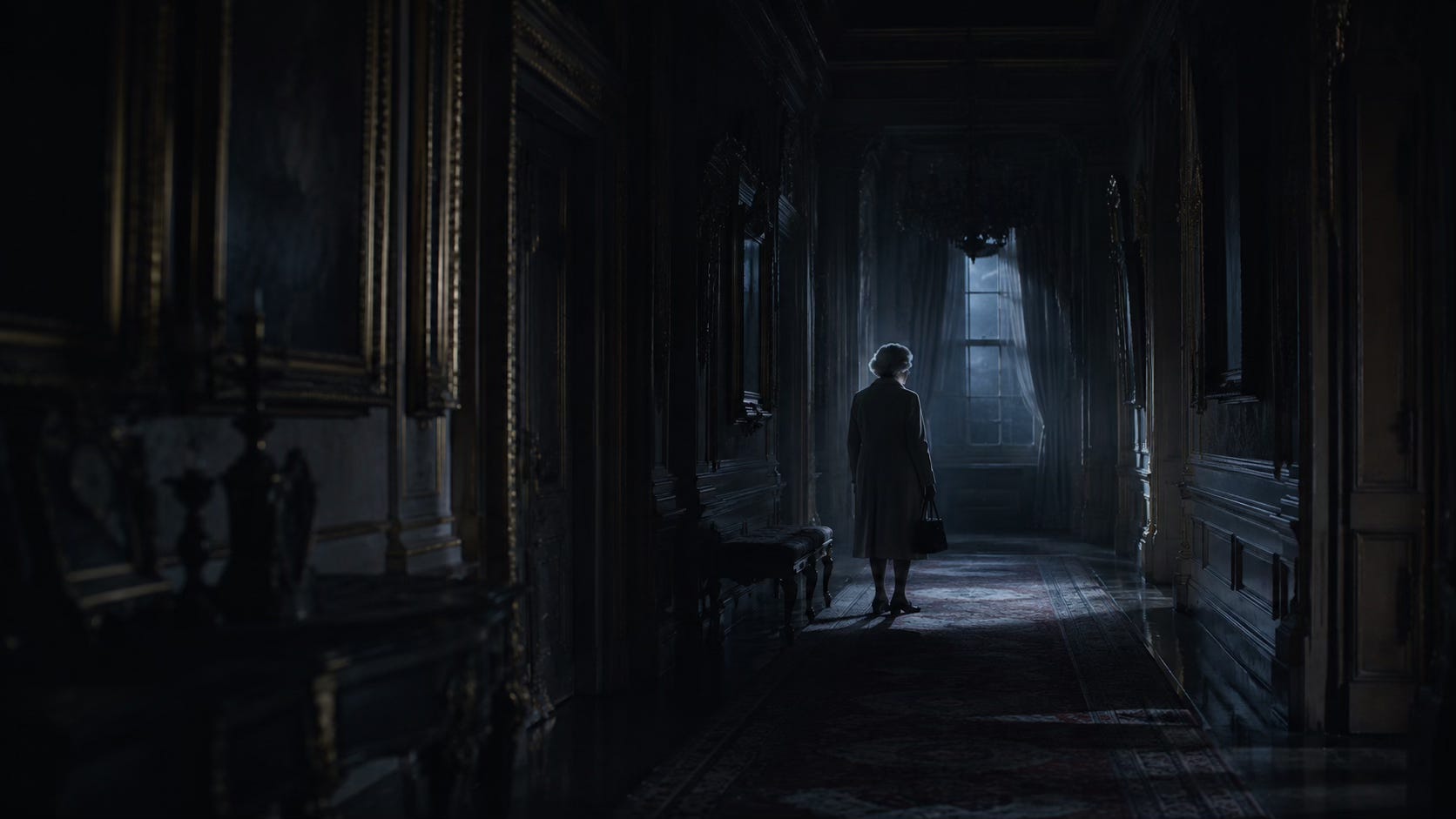
I was about to close the laptop when she appeared, as she tends to, in the peripheral way that is entirely her own. Not announced. Never announced.
Which is, I reflected, something of a change in protocol.
“They used to announce you, you know,” I said.
“Rather a lot of fuss” she said, with the faint amusement of someone reflecting on a habit that now strikes them as faintly absurd.
“The institution requires fuss,” I said.
“The institution,” she replied, “requires continuity. The fuss is optional.”
Simply present, in the way that certain presences make themselves felt in old houses late at night, when the rest of the world has gone to sleep and the silence gets thick enough to have texture.
“Nothing to write about?” she asked.
“Very little,” I admitted.
“Good,” she said.
And there it was. That particular quality of satisfaction that I have come to associate with someone who spent the better part of a century understanding that the most important things an institution does are frequently invisible. The absence of drama is not an accident. It is, when managed properly, the entire point.
She had always understood this better than almost anyone around her. The function of the monarchy is not to generate headlines. It is to endure. To show up. To cut the ribbon and read the speech and stand in the rain without complaint and make the whole complicated business of national identity feel, if not simple, then at least continuous. The noise, when it came, was always a symptom. The quiet was the thing itself.
“No talk of cancer,” she observed, after a moment.
“Other than a successful appearance by the Princess of Wales, no.”
“No jam.”
“No.”
She seemed genuinely pleased by this, in the way one is pleased when something that has been through considerable difficulty simply holds. I thought about the months behind us. The investigations. The documentaries. The interviews. The books, God help us, the books. The sense, at certain moments, that the whole edifice was being tested in ways that even its most resilient occupants had not anticipated.
And yet the flowers still go up the Mall. The Changing of the Guard still draws its crowds. Catherine had been back on overseas engagements, composed and purposeful and carrying whatever she carries with a grace that asks nothing in return for the effort it clearly requires. Charles had continued his schedule with the particular doggedness of a man who understands that the schedule is itself the message.
The institution, in other words, was doing what institutions are supposed to do. Getting on with it.
I said something to this effect, and she made a sound that was not quite agreement and not quite dismissal.
“They’re resilient,” she said. “When they choose to be.”
The qualifier landed quietly, but it landed.
We sat with that for a moment, the way one sits with things that have more than one meaning.
And then she said, with a shift in register I recognised: “I do feel for the boy.”
I knew which boy. There was only ever one boy when she said it that way, in that particular tone, which was not sentimental and not excusing and not without a certain residual grief that I suspect will simply always be there, embedded in whatever she is now.
The wedding.
“He chose the distance,” I said, because it is true and because someone has to say it.
“Yes,” she said. “They usually do.”
A pause.
“Doesn’t make the chair any less empty.”
I thought about Harry, specifically. Not the Harry of the interviews or the memoir or the carefully constructed narrative of injury and exile. The earlier one. The one she had known at Balmoral and at Christmas and at all the private occasions that never made it into any documentary because they were simply family, doing what families do. I thought about how much of what he had been given he had not, perhaps, fully understood he was being given, and how that particular form of not-knowing tends to announce itself only in retrospect, when the thing is no longer there to be taken for granted.
She had moved on, as she does, before I had finished thinking about it.
“The little girl,” she said. “They kept the name.”
“They did.”
“People were so exercised about it.” There was something faintly amused in her voice, the tone of someone who has watched human beings work themselves into a state about things that are, in the long accounting, quite small. “It’s a child’s name. A perfectly good name. Names don’t take anything from anyone.”
This is, I think, correct. The debate around Lilibet’s name was always more revealing about the people having it than about the name itself. The suggestion that it was an imposition, or a provocation, or a kind of claim being staked, said rather a great deal about what people had decided to think about the parents, and rather less about a small girl who did not choose her name and cannot be held responsible for the feelings it generates in adults who should, on balance, know better.
She paused, and then said, more quietly: “Perhaps, in time, when someone says it, they’ll think of an old lady. Just for a moment.”
I told her I thought that was likely.
“It wouldn’t be the worst legacy,” she said.
There was something in this that I found difficult to answer, and so I didn’t try. There are moments in these late-night conversations where the right response is simply to let the thought settle where it lands, without the noise of commentary around it.
The screen was still blank. The cursor still blinking.
Outside, the city was doing what cities do at this hour: breathing slowly, keeping its own counsel, getting on with the long unconscious business of being.
I thought about the week just past. The non-events of it. The quiet. The functioning. The family gathering without the full complement of those who might have been there, and somehow continuing anyway, because that is what they do, and perhaps what they have always done, and perhaps what she understood better than anyone when she was here to understand things.
I closed the laptop.
The room was empty again.
I went to bed.
Just when you & your lovely ghost thought that the Monarchy & British Royal Family were having a quiet week, up pops an audit that has given validation & proof of what many have suspected & alleged of the mismanagement of HM QEII's & KCIII's Crown Estate has been conducted in the past couple of decades. The National Audit Office in their report released on June 5, 2026 has revealed deep flaws in the way that royal "grace & favour" homes for royal family members are managed. While nothing illegal or illicit has been revealed, the optics of this management are terrible -- to the public, to the MPs who will receive the full report. The detailed report titled "Investigation into residential property arrangements with members of the Royal Family" exposes major inconsistencies, highly favorable lease terms, & opaque financial practices across properties managed by The Crown Estate & The Royal Household. This is evident despite the Palace's statement welcoming the NAO's factual review of royal property arrangements, stating it aligns with the Royal Household's commitment to transparency. It's quite obvious that this statement is a band-aid on a broken leg.
The key findings of this report include -- undisclosed Private Income: AMW collected private rental income by subletting 3 cottages on his RL estate for over 2 decades while only paying a symbolic "peppercorn rent" to the Crown Estate. Subsidized Rents for Non-Working Royals: Beatrice & Eugenie lived in a KP apartment & a KP cottage under discounted "grace & favour" terms. Queen Elizabeth & King Charles III funded these costs through the private Privy Purse income. Outdated Property Valuations: The Royal Household calculated adjusted rental rates for several palace properties using historic, outdated market valuations rather than modern, fair-market appraisals. Unequal Rental Terms: While working royals occupy residences free of charge in exchange for official duties (which seems very fair), other senior royals like the Edinburghs also held leases allowing them to benefit from property subletting.
While all these are relatively small in comparison to the recent debacles & unhappiness of the public with the way the King is managing some of his relatives in other situations, it seems like the time of this report & its key findings are coming at a very vulnerable time for the British Monarchy. It remains to be seen what improvement results will result in a sure-to-happen dialog between the Crown Estate, Monarch & Parliament.
I do think giving Lilibet that name was definitely a provocation and claim being staked - by Meghan, not the child. Did Meghan have a copyright or something on the name?
How can you doubt the obvious - Meghan attaching herself as many ways as possible to her only important achievement - marrying Prince Harry?