
Normal Service Resumed, Regrettably
A brief and rather pleasant fortnight of proper royal coverage has ended.
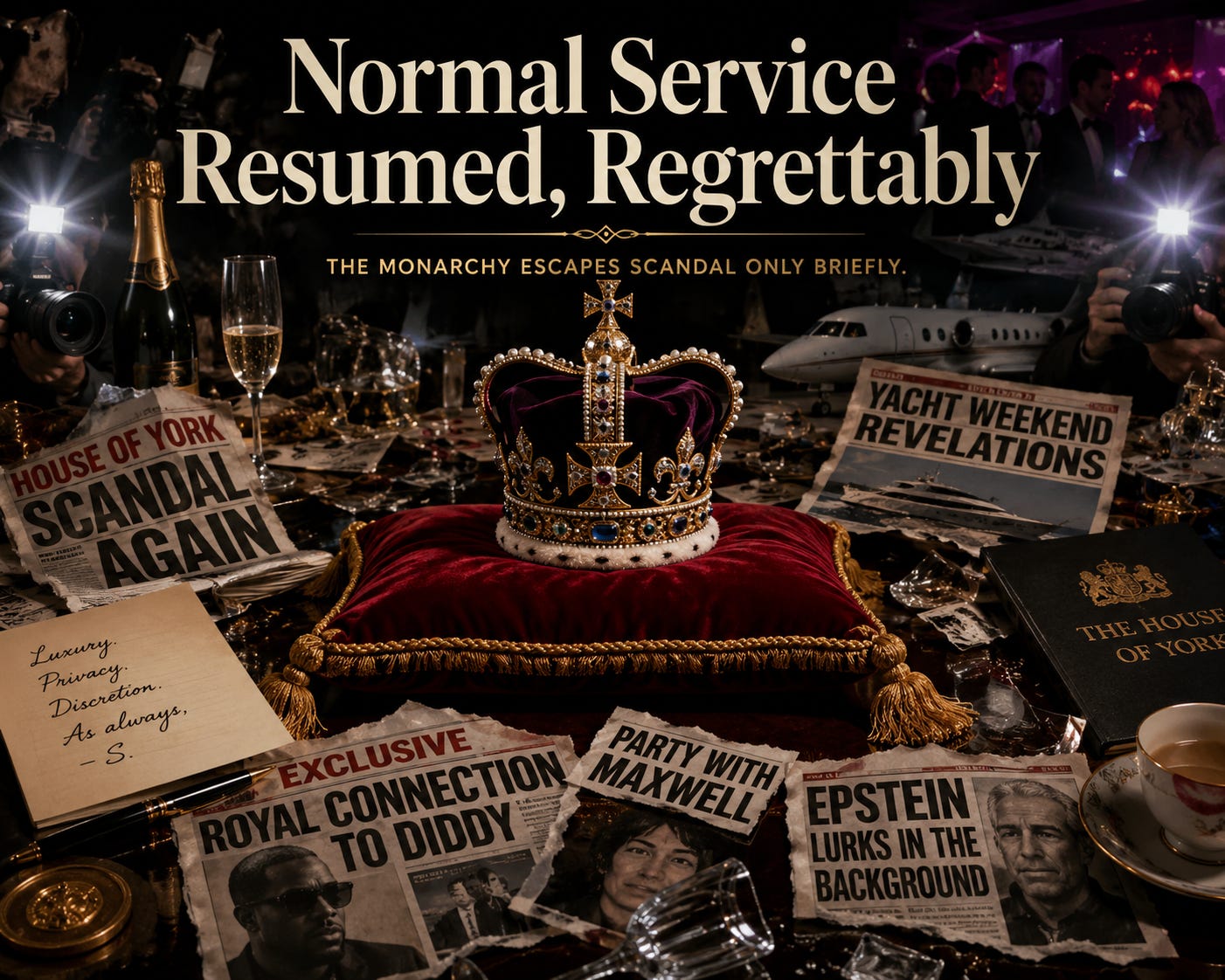
For a brief and rather pleasant fortnight, it was possible to discuss the British Royal Family in terms one might use in polite company. There was the centenary of the late Queen’s birth, observed with appropriate solemnity. There was the King’s state visit to Washington, conducted with rather more grace than anyone had reasonably anticipated. There was, in short, the institution doing what the institution is supposed to do. One allowed oneself a cautious optimism.
The story now circulating concerns Andrew Lownie, a royal author of some persistence, and his updated edition of Entitled, his examination of the House of York. The new material centres on Sarah Ferguson and her alleged association with Sean Combs, the American rapper and convicted criminal known formerly as P Diddy, who is currently serving a prison sentence for transportation for prostitution. Lownie claims the two began a relationship in 2004, having first met two years earlier at a party hosted by Ghislaine Maxwell. One pauses to let that particular detail settle.
Lownie’s sources, described as former employees of Combs, allege the relationship continued for several years, conducted across luxury hotels in Europe and Africa, including one establishment reportedly costing in excess of fifty thousand pounds per night. A source close to Ferguson has described the claims as fabricated nonsense. Lownie says he stands by every word. I have no means of adjudicating between them, and I am not certain I wish to.
What I will observe is that the cast of characters assembled in this story, Combs, Maxwell, Epstein lurking in the background as he invariably does, represents a constellation of association that the House of York has somehow managed to collect with a consistency that defies ordinary explanation.
One could, in an earlier era, have reasonably hoped that a story of this nature might peak, generate its requisite column inches, and then recede. That is not how these things work anymore, and it is worth pausing to consider why.
The modern media environment does not allow stories to settle. What once might have occupied the tabloids for a news cycle or two now propagates across platforms simultaneously, each iteration adding a fresh layer of speculation, commentary, or outrage. A claim made in a book extract in the Daily Mail on a Friday morning is, by Friday afternoon, a Twitter argument, a podcast segment, a Reddit thread, and an American cable news chyron. By Saturday it has acquired sub-stories. By Sunday someone is demanding a parliamentary inquiry. By Monday, a man who considers himself a serious student of constitutional monarchy finds himself typing the words “seven-star hotel” and “friends with benefits” into what he had always imagined was a rather dignified publication. The machinery does not switch off, and it does not distinguish between allegation and established fact with any great rigour.
This matters particularly for the Royal Family because the institution has no adequate mechanism for responding to the cycle’s velocity. The Palace operates, by design and by instinct, at a stately pace. Statements are considered, lawyers are consulted, positions are calibrated. All of this takes time that the news cycle is entirely unwilling to provide. The result is that the institution is perpetually reactive, perpetually behind, perpetually watching stories calcify into received wisdom before it has managed to say anything coherent in response.
Ferguson, it should be noted, is no longer a working royal. Her connection to the institution is familial and historical rather than operational. And yet the stories attach themselves to the Crown regardless, because the public and the press do not maintain the careful distinctions that those inside the institution would prefer. The House of York remains, in the public imagination, royal. What touches it touches the wider family, however unfairly.
This is the tax the modern monarchy pays for its continued relevance. An institution that wishes to remain central to national life must accept that it will remain central to national gossip as well. The two cannot be cleanly separated, much as those of us who cover the institution more seriously might prefer otherwise. One spent two rather agreeable weeks discussing statecraft and centenary commemorations. The wheel has now turned, as it always does, and here we are again.
I do not doubt that further details will emerge. Lownie is not a man who publishes and retreats. The updated paperback arrives on the twenty-first of this month, and one anticipates that the intervening period will not be quiet. Those within the institution who had allowed themselves to exhale following a genuinely successful fortnight are advised to hold their breath once more.
The farce, as ever, has its own schedule, and it does not consult ours.
This is a repeat comment. The public understands that the Monarch cannot control individual members' behaviors. The Monarchy CAN control whether it continues to endorse an individual's behavior, once knowledge of it exists, through allowing them to retain titles and other benefits.
Timely, effective action in such situations is the measure of the power and judgment of the Monarch.
So far the British Monarchy has been investing a lot of money in PR specialists, crisis managers in the sense of stomping out flames once there is a fire, digital archives specialists, estate managers etc. What if they put more money & emphasis into themselves & key aides on behavioral analysis, leadership, EQ training, teamwork & group dynamics training & best of all bring in the Princess of Wales & actually study & listen to early childhood development strategies. Go a little further than the etiquette/diplomatic briefings they get before assuming public duties. The Monarch & the principal heirs would benefit greatly to develop the skills & training that other corporate leaders do. And because they're a family & family members are engaged in the work, these folks would benefit greatly by team & family dynamics skills & educational development too. So far Monarchs seem to think a regular set of skills gained from whatever little ed (in some cases VERY little, King Charles is the only British monarch in history to have earned a university degree) or military training they've received is sufficient. If looked at as a specialty corporation (or actually as the "nation state" as a company model) the monarchy is arguably #1 in terms of global name recognition, cultural influence, & traditional soft power. It serves as a, if not 'the', premier global, state-backed brand. It commands billions of pounds in assets & generates billions of pounds in tourism & consumer perception. How many other large corporate type organizations would have at the top management level such poorly skilled & educated/training executives running the show?